Application
Armoured cables are used for power transmission and distribution where mechanical protection is essential. They are ideal for underground installations, industrial environments, outdoor power networks, and areas exposed to physical stress. Common applications include electrical supply to buildings, machinery, control systems, and high-risk environments such as construction sites and manufacturing plants.
Conductor
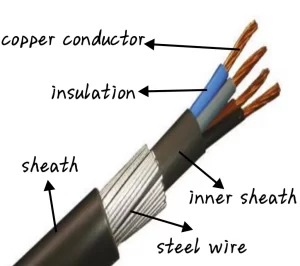
Armoured cables typically use copper or aluminium conductors, available in single-core or multi-core configurations. Copper offers superior conductivity, while aluminium provides a lightweight and cost-effective alternative for longer runs.
Insulation
The conductors are insulated with PVC, XLPE, or EPR, depending on the voltage rating and application. These insulation materials provide excellent electrical resistance, thermal stability, and protection against environmental factors such as moisture and heat.
Armouring
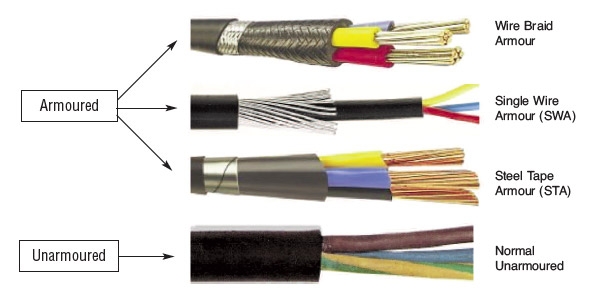
The armouring layer is what sets these cables apart. It consists of:
- Steel Wire Armour (SWA): Used for multi-core cables, providing robust protection against impact and mechanical damage.
- Steel Tape Armour (STA): Used in some designs for lighter mechanical protection.
- Aluminium Wire Armour (AWA): Used for single-core cables to avoid magnetic interference.
This metallic armouring allows the cable to withstand external mechanical stress, making it suitable for direct burial or installation in harsh environments.
Sheathing
An outer sheath—usually made from PVC, LSZH (Low Smoke Zero Halogen), or PE—protects the cable from environmental damage, corrosion, UV exposure, and chemicals.
Benefits
- Mechanical Protection: Resists crushing, impact, and rodent damage.
- Durability: Designed for long service life even in challenging environments.
- Fire Resistance: Flame-retardant sheathing options available.
- Weatherproof: Suitable for both indoor and outdoor use.
- Versatile: Applicable across residential, commercial, and industrial sectors.
Marking
Each armoured cable is clearly marked with details such as conductor size and type, number of cores, insulation type, voltage rating, standard (e.g., BS5467, IEC), and manufacturer name. This ensures traceability and compliance with technical requirements.